 uality Duck
How to Harness Your Behavioural Wake to Amplify Culture
There is a concept in leadership theory that has shaped how I act in my role for years: The Behavioural Wake.
Imagine a boat moving through the water. Behind it, it leaves a wake. Depending on how the boat is driven, that wake can be a smooth, flat path that makes it easier for other boats to follow. Or, it can be a choppy, chaotic mess that rocks everyone else around it.
As leaders, we are the boat and our behaviour sets the water behind us. Every interaction we have, whether in a high-stakes meeting or a casual coffee chat, leaves a wake behind us.
Early in my career, I focused entirely on the “destination” (the code, the release, the metrics). But as I moved into leadership, I realised that how I got there mattered just as much.
The Amplification Effect
One of the hardest lessons to learn when you transition from Individual Contributor to Leader is that you are suddenly under a magnifying glass.
- If you are a Junior Engineer and you have a bad day, you might be quiet in the stand-up. Your team might check in on you.
- If you are the Head of Engineering and you are quiet in the stand-up, the team starts to panic. “Is there a layoff coming? Is the project being cancelled? Did we mess up?”
Your actions are amplified. A heavy sigh from a leader can sound like a thunderclap to the team.
This is the Negative Wake. If you allow your stress, frustration, or cynicism to leak out unchecked, you create an environment of anxiety. You might not intend to, but you are effectively “polluting” the psychological safety of the room.
The Positive Ripple
The flip side, however, is equally powerful.
If negativity is contagious, so is resilience. When a leader remains calm during an outage, the team thinks clearly. When a leader shows genuine enthusiasm for a small win, the team feels valued.
I have seen entire departments turn around not because of a process change, but because the leadership changed the emotional tone. By presenting a “best self”, one that is grounded, optimistic, and supportive, you create a wake that lifts everyone up.
Authenticity vs. Performance
Now, this doesn’t mean you can’t be yourself.
I am a big believer in authenticity. It is okay not to be perfect every day. We are humans, not AI. If you are burned out, pretending to be happy is “Toxic Positivity,” and engineers can smell that a mile away.
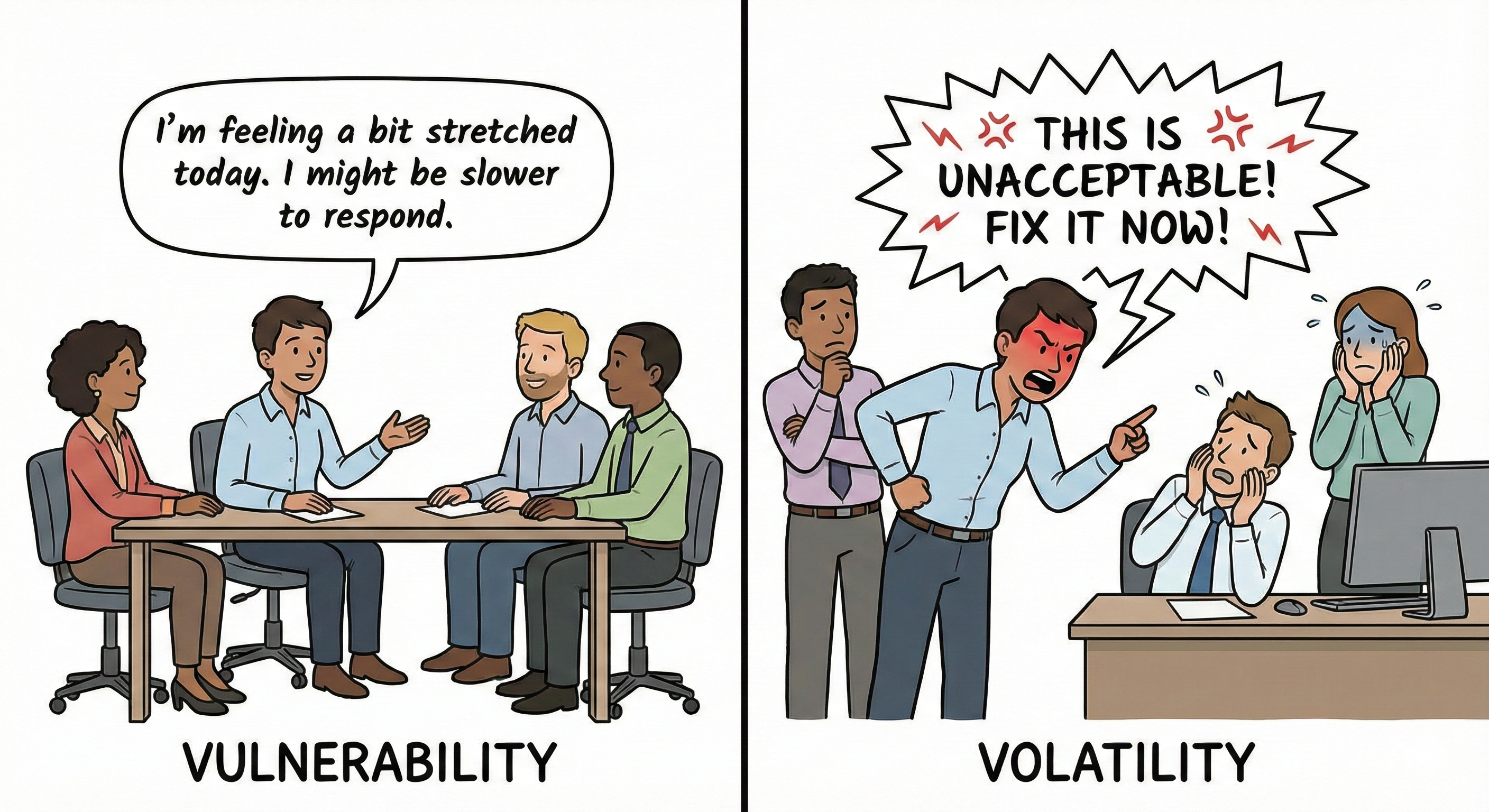
However, there is a difference between Vulnerability and Volatility.
- Vulnerability: “I’m actually feeling a bit stretched today, so I might be a bit slower to respond.” This is human and builds trust.
- Volatility: Snapping at an engineer because you are stressed about a budget meeting destroys trust.
The “Oxygen Mask” Rule
So, how do we manage our wake when we are stressed?
- Self-Awareness: Before you join a call, check your pulse. Are you carrying the anger from the last meeting into this one? If so, take a minute. Let the person know you are running a couple minutes behind and take the opportunity to breathe. Reset.
- Vent Up, Not Down: If you need to complain, do it with your peers or your mentor, never with your team. Your job is to shield the team from the chaos, not amplify it.
- Take the Time: As my notes for this post reminded me: “Take the time you need for yourself so that you can present your best self to others.”
If you are running on empty, you cannot leave a smooth wake, and the turbulence spreads faster than you might think. Stepping away for an hour to clear your head isn’t selfish; it’s a service to your team.
Why is this the oxygen mask rule? Because taking care of yourself isn’t just about you, it’s about your ability to care for others.
The Legacy of a Positive Wake
Beyond just avoiding toxicity, a positive wake is your strongest tool for retention and growth.
People rarely remember the specific Jira ticket you helped them unblock, but they will always remember how you made them feel during a crisis. When you consistently show up with empathy, stability, and calm, you build a reservoir of loyalty that money can’t buy. People want to work with you, not just for you.
Even better, a positive wake is contagious. Leadership is learned by osmosis. When your team sees you handling pressure with grace, they learn to do the same. You aren’t just leading a team today; you are teaching the next generation of engineering leaders how to lead tomorrow.
Summary
Always remember: every meeting, every call, every chat over coffee, and every time you walk in the room, you are setting the culture.
So when you need to, take a pause to ensure that the culture you are building in that moment is the one you and your team want to work in.
The code we write will be refactored. The features we ship will be replaced. But the way we make people feel, through the wake we leave behind, can outlast your career and influence others long after you are gone.
Further reading
If you enjoyed this post then be sure to check out my other posts on Engineering Leadership.
Join the flock
Subscribe to get the latest posts on the messy reality of software delivery sent directly to your mailbox. I regularly share new thoughts on leadership and strategy —zero spam, just value.
Attributions
Featured image by Edmont – Own work, CC BY-SA 3.0, https://commons.wikimedia.org/w/index.php?curid=6920796