 uality Duck
How to be a leader without a promotion
Leadership is often equated with titles, org charts, and direct reports. But that’s a narrow view.
True leadership is influence, not authority. You don’t need a management role to lead — you can shape projects, culture, and outcomes as an individual contributor (IC). If you’ve ever felt limited by your title, this post is for you.
Leadership is a choice, not a promotion.
Output vs. Leverage
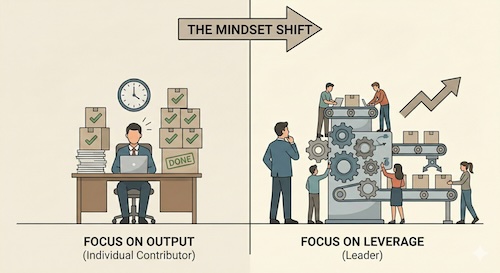
The biggest mindset shift required to lead as an IC is moving from a focus on Output to a focus on Leverage.
As an IC, your contribution is often measured in commits, pull requests, and ticket closures. But as a leader, your contribution is measured in the success of others: the velocity they achieve, the mistakes they avoid, and the improvements they implement because of your guidance.
Leverage is about intentionally shifting your energy from “doing everything myself” to “creating systems, habits, and support that allow the team to do more than I ever could alone.”
That’s not a small distinction. It’s the whole game.
The Three Pillars of Leadership
Leading isn’t about controlling people or assigning tasks. It’s about taking initiative, guiding decisions, and enabling your peers to achieve more. This usually manifests in three ways.
1. Project Leadership (Delivery)
Project leadership doesn’t require authority, it requires clarity and persistence. A strong leader coordinates cross-team initiatives, defines success metrics, and drives delivery without needing to be anyone’s manager. This kind of leadership often has greater ripple effect than direct management, because it influences multiple teams and outcomes simultaneously.
The Lever: Streamlining workflows and clarifying responsibilities removes friction and allows others to focus on what matters, delivery.
2. Thought Leadership (Strategy)
Sharing knowledge and perspective is a form of leadership. Offering guidance grounded in business context, challenging assumptions constructively, and helping others make informed decisions earns respect and attention. This is influence that travels further than a job title ever could.
The Lever: Documentation and patterns. Capturing solutions, design decisions, or troubleshooting guides prevents repeated mistakes. Your experience becomes reusable across the team, scaling your wisdom even when you aren’t in the room.
3. Cultural Leadership (Behaviour)
Shape culture through behaviour: listening actively, encouraging dissenting opinions, recognising contributions, and amplifying voices that are often overlooked. These actions build trust and psychological safety, making the team more resilient and more productive.
Culture leadership is largely invisible, but it affects how decisions are made, how risk is discussed, and how quality is approached.
The Lever: Mentorship. Helping teammates grow their skills and confidence accelerates the team’s overall velocity. A few hours invested in a junior can save weeks of trial-and-error down the line.
Real-World Examples
The Unblocker: Notices that the team’s retrospectives keep surfacing the same issues without resolution. Takes ownership of facilitating a structured follow-through process, turning recurring complaints into tracked actions with owners. Delivery improves, not because the team changed, but because someone made the friction visible and kept pulling the thread.
The Scaler: Identified a slow feedback loop and worked with teams to resolve it by improving the CI/CD pipeline and the team’s understanding of what it does. Resulted in improved confidence in changes and an understanding of what is needed when a pipeline fails.
The Coach: Spots that onboarding is inconsistent and relies too heavily on tribal knowledge. Pairs with new joiners deliberately, documents the unwritten rules, and creates space for questions that people are afraid to ask in group settings. Within a few months, new starters are contributing meaningfully faster and the team barely notices the change because it just feels like culture now.
None of these required a management title. All of them had a management-level impact.
The Multiplier Effect
Transitioning from Contributor to Leader isn’t about increasing your own output, it’s about multiplying the output of those around you.
The question stops being “What did I build?” and becomes “What did we build together because of me?”
Where to start
This week, pick one area where you can scale your influence: mentor someone, document a repeatable solution (and share it), simplify a process, or facilitate a conversation that needs to happen. Start small. The compounding effect is real.
It isn’t what your org chart says, it’s what your peers experience because of your actions that defines your leadership.
Further reading
If you enjoyed this post then be sure to check out my other posts on Engineering Leadership.
Join the flock
Subscribe to get the latest posts on the messy reality of software delivery sent directly to your mailbox. I regularly share new thoughts on leadership and strategy —zero spam, just value.